Returning to the Workplace:
What Motivates Employees in the Post-COVID Era?
ISON Psychometrica
Boyden Greece & Cyprus
Insights
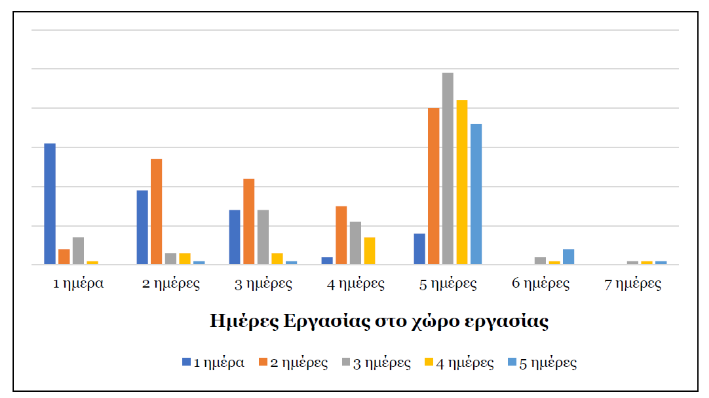
Ideal number of workdays per week
As revealed by the survey conducted by ISON in collaboration with Boyden in September–October, contrary to expectations, employees are not demanding full remote work; rather, they have different needs and preferences based on the
number of days they currently spend at the workplace.
Employees envision their ideal work environment based on
their current work situation, rather than an idealized, unrealistic one. Specifically, they would like to work at the employer’s premises one or two days fewer than they actually do.
This chart shows the ideal workdays (colored columns) compared to the actual workdays at the workplace.
Which needs were identified as the most important?
76,7%
---------------
Need for recognition. This refers to an individual's need to have their work recognized by others.
62,7%
---------------
Need for power. This refers to a person's desire to exert influence and make important decisions
44,3%
---------------
The need for selflessness. This refers to providing assistance in any context, whether work-related or not.
What motivates employees?
Equally interesting is the ranking of Values and
Motivators, with the results surprising and challenging
stereotypical perceptions and assumptions in the workplace.
One such example is the finding that mental and physical health initiatives are a more important motivator than the provision of
supermarket gift cards, a standard and frequently used corporate practice
for rewarding and motivating employees.
The findings of the study
not only shed light on how employees perceive their place in the world of work, but also offer a unique perspective on the values and motivations that, when combined appropriately, can serve as success factors in creating a more attractive and socially conscious work environment.
Research Framework
The onset of COVID-19 marked a turning point for all aspects of human life, including work.
The exponential growth of remote work and hybrid work created an immediate need to investigate and understand what this change means for employees.
ISON Psychometrica and Boyden Greece & Cyprus conducted one of the first surveys in Greece on the motivations and values that play a role in employees’ return to the workplace.
Research Summary
Research Summary
The study comprises three levels of analysis. In the first phase, it provides demographic
data on the participants to ensure the integrity of the study and its
value as a representation of the reality of the workplace in Greece.
Second, it provides a detailed analysis of Motivators (such as flexible work schedules,
additional vacation days, and recreational or sports activities) and
Values (such as commitment to goals, teamwork, and selflessness). Based on
these, readers can gain an in-depth understanding of the needs of Greek
workers, with the ultimate goal of gaining valid insights into ways
to bring them back to the workplace.
Finally, the report provides conclusions based on statistical analyses at
all levels. For example, it presents the categories of workers that
emerge from the interaction of motivations and values, and, by extension, the
ways in which one can motivate them to return to their
workplaces.
If you are interested in the full study, please contact us